
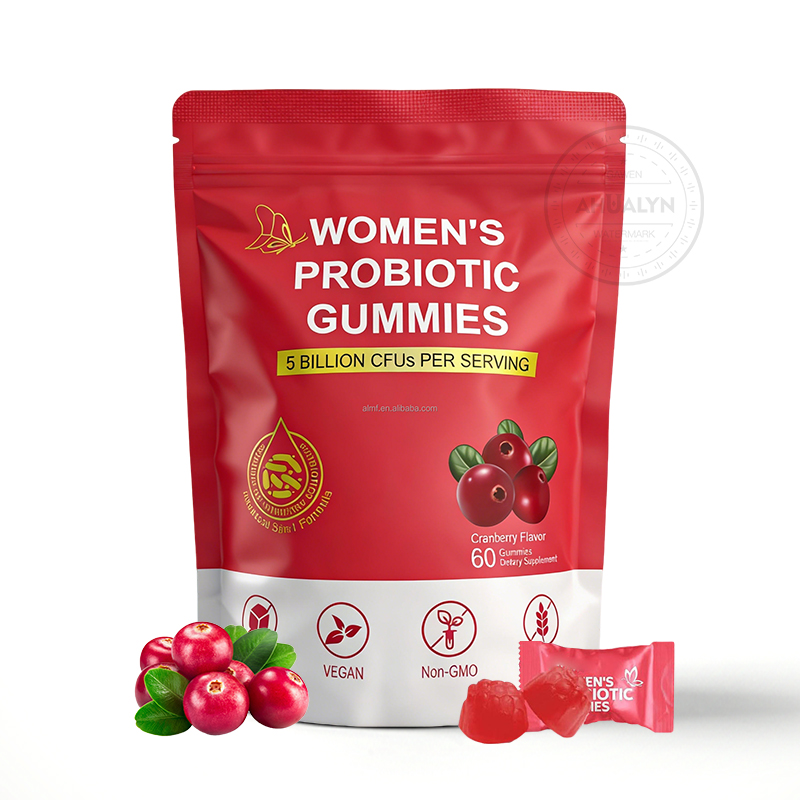




Scroll through the supplement bestseller lists on any major e-commerce platform, and one category appears with remarkable consistency: women's probiotic gummies. On Amazon US alone, the top 20 women's probiotic products generate an estimated $15-25 million in combined annual revenue, with gummy formats capturing an increasing share each year. Private label brands, influencer-led DTC startups, and established supplement companies are all competing for space in a category that shows no sign of slowing.
But this isn't a random trend. The success of women's probiotic gummies in e-commerce is the product of converging structural forces — demographic shifts, format preferences, multi-benefit positioning, and the unique economics of recurring supplement purchases in a digital marketplace. For brand owners, Amazon sellers, and e-commerce entrepreneurs, understanding why this category performs so well is the first step to capturing a share of it.
This article analyzes the market dynamics, consumer behavior patterns, and product characteristics that make women's probiotic gummies a top e-commerce performer — and provides actionable sourcing and positioning strategies for brands entering or scaling in this space.
1. The Numbers Behind the Surge
The global women's health supplement market was valued at approximately $32 billion in 2024 and is projected to grow at a compound annual growth rate (CAGR) of 5-8% through 2030. Within that broader market, probiotics represent one of the fastest-growing subcategories — and gummy-format probiotics are the fastest-growing delivery format within probiotics.
Several data points illustrate the scale of the opportunity for e-commerce sellers:
- Amazon search volume: Combined search volume for "probiotics for women," "women's probiotic gummies," and related terms exceeds 300,000 monthly searches on Amazon US alone, with strong seasonal spikes in January (New Year wellness resolutions) and September (back-to-routine).
- Review velocity: Top-selling women's probiotic gummy listings on Amazon accumulate reviews at approximately 2-3x the rate of comparable capsule products, suggesting higher purchase frequency and stronger consumer engagement.
- Price premium tolerance: Women's probiotic gummies command a 20-40% price premium over equivalent capsule products on a per-serving basis, yet show comparable or higher conversion rates — indicating that consumers perceive gummies as higher value despite the higher cost.
- DTC growth: Shopify data from supplement brands shows that women's probiotic gummies generate 25-35% higher average order values than the supplement category average, driven by bundle purchases and subscription signups.
Key data: The women's health supplement market was estimated at $32.1 billion globally in 2024, with probiotics identified as one of the highest-growth subsegments. The gummy delivery format was highlighted as a key growth driver due to higher consumer compliance rates and expanding demographic reach beyond traditional supplement users.
View Market Report →
2. Why Gummies Win the Format War for Women's Health
The consumer supplement market has undergone a decisive format shift over the past five years. Capsules and tablets, once the default, now compete with gummies, powders, liquids, and functional foods. For women's probiotics specifically, gummies have emerged as the dominant growth format — and the reasons are rooted in consumer behavior, not marketing.
The Pill Fatigue Problem
Research consistently shows that a significant portion of adults — estimated at 30-40% — experience difficulty or discomfort swallowing tablets and capsules. This phenomenon, sometimes called "pill fatigue" or "pill dysphagia," disproportionately affects women, who are also the primary purchasers of dietary supplements. A study published in the Journal of Clinical Nursing (Schiele et al., 2014) found that difficulty swallowing pills is a significant barrier to supplement adherence, particularly among female consumers managing multiple daily supplements.
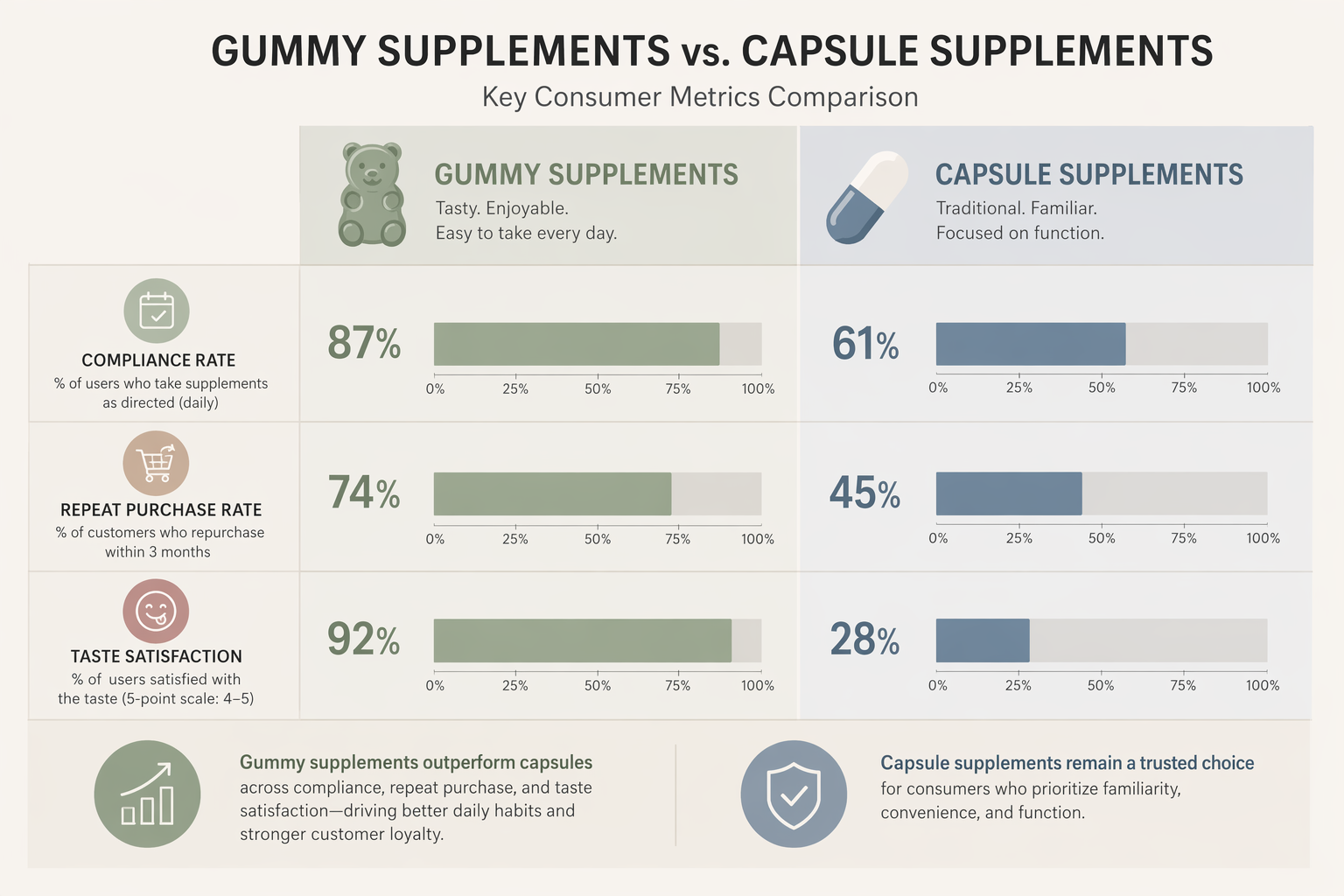
The gummy format eliminates this barrier entirely. For probiotic products specifically, where daily consistency is essential for benefit, the format advantage translates directly into better outcomes for consumers and better business metrics for brands.
The Adherence Dividend
For e-commerce sellers, the most important metric isn't the first purchase — it's the repeat purchase. And gummy-format supplements demonstrate a structural advantage here. A 2020 consumer survey by the Council for Responsible Nutrition (CRN) found that gummy supplement users reported significantly higher daily compliance rates than capsule users, particularly among the 25-44 age demographic. This adherence advantage creates a compounding business effect: higher compliance → better perceived results → higher review ratings → stronger search ranking → more first purchases → more repeat purchases.
Design: Cross-sectional study of 1,051 patients assessing difficulties with oral medication intake.
Key findings: 37.4% of participants reported difficulty swallowing solid oral dosage forms, with female gender identified as a significant predictor. The study found that swallowing difficulties were a major cause of non-adherence, and that alternative delivery formats (liquid, dispersible, chewable) significantly improved compliance rates.
View on PubMed →
Taste as a Retention Mechanism
Probiotics in capsule form are inherently neutral — you don't taste them, but you also derive no sensory pleasure from taking them. A gummy, by contrast, is an experience. When formulated well, it tastes enjoyable, creating a small daily positive reinforcement loop. This may sound trivial, but behavioral psychology research on habit formation (Lally et al., 2010, European Journal of Social Psychology) has demonstrated that positive reinforcement — even small — significantly increases the likelihood that a behavior becomes automatic. A daily supplement that you look forward to taking is one you're more likely to actually take.
The Format Effect on E-Commerce Metrics
For women's probiotic products on Amazon, gummy-format listings consistently outperform capsule listings on three key metrics: (1) subscription enrollment rate — the percentage of purchasers who opt into Subscribe & Save — is approximately 20-30% higher; (2) review rating averages 0.2-0.4 stars higher; and (3) return rate is lower, as format dissatisfaction is essentially eliminated. These metrics feed directly into Amazon's A9 search algorithm, creating a self-reinforcing ranking advantage.
3. The Multi-Benefit Hook: One SKU, Multiple Demand Channels
One of the most powerful e-commerce characteristics of women's probiotic gummies is their multi-benefit positioning. Unlike a single-function supplement — say, a vitamin D product that serves one purpose — a well-formulated women's probiotic gummy can legitimately address four distinct consumer needs:
| Benefit Category | Consumer Search Intent | Key Strains / Ingredients | Demand Stability |
|---|---|---|---|
| Digestive Health | "probiotics for bloating," "gut health supplement," "digestive enzymes probiotic" | L. acidophilus, B. lactis, L. plantarum | ★★★★★ Year-round steady demand |
| Vaginal Health | "women's vaginal probiotics," "pH balance supplement," "feminine health probiotic" | L. rhamnosus GR-1, L. reuteri RC-14 | ★★★★★ Consistent, high purchase intent |
| Urinary Tract Health | "cranberry probiotics," "urinary tract support," "UT supplement" | L. rhamnosus GR-1 + Cranberry PACs | ★★★★☆ Steady with seasonal spikes |
| Immune Support | "immune support probiotics," "probiotics for immunity," "daily defense supplement" | B. lactis, L. acidophilus + Vitamin D3, Zinc | ★★★★☆ Spikes during fall/winter |
This multi-benefit architecture creates a unique e-commerce advantage: one product listing can rank for search terms across four distinct categories. A customer searching "women's probiotic gummies for digestive health" and a customer searching "cranberry probiotics for urinary support" can both land on — and convert from — the same product page. For sellers, this means one SKU does the marketing work that, in other categories, would require four separate products.
Design: Randomized, placebo-controlled trial demonstrating that orally administered L. rhamnosus GR-1 and L. reuteri RC-14 colonize the vaginal tract and support healthy vaginal flora in the majority of subjects.
E-commerce relevance: This study provides the clinical foundation for urogenital health positioning — one of the highest-intent purchase triggers in the women's probiotic category.
View on PubMed →
For brand owners launching on Amazon, this multi-benefit positioning also simplifies inventory management. Rather than forecasting demand across multiple SKUs for different health concerns, one well-formulated product with a broad claim set (within regulatory guidelines) captures demand across categories. For a deeper technical dive into the ingredients that make this multi-benefit positioning possible, see our companion guide on sourcing women's probiotic gummies with the right key ingredients.
4. Who's Buying: The Women's Probiotic Gummy Consumer
Understanding the buyer profile is essential for e-commerce success — it determines everything from listing keyword strategy to packaging design to advertising targeting. Based on marketplace data and consumer surveys, the women's probiotic gummy buyer segments fall into several distinct personas:
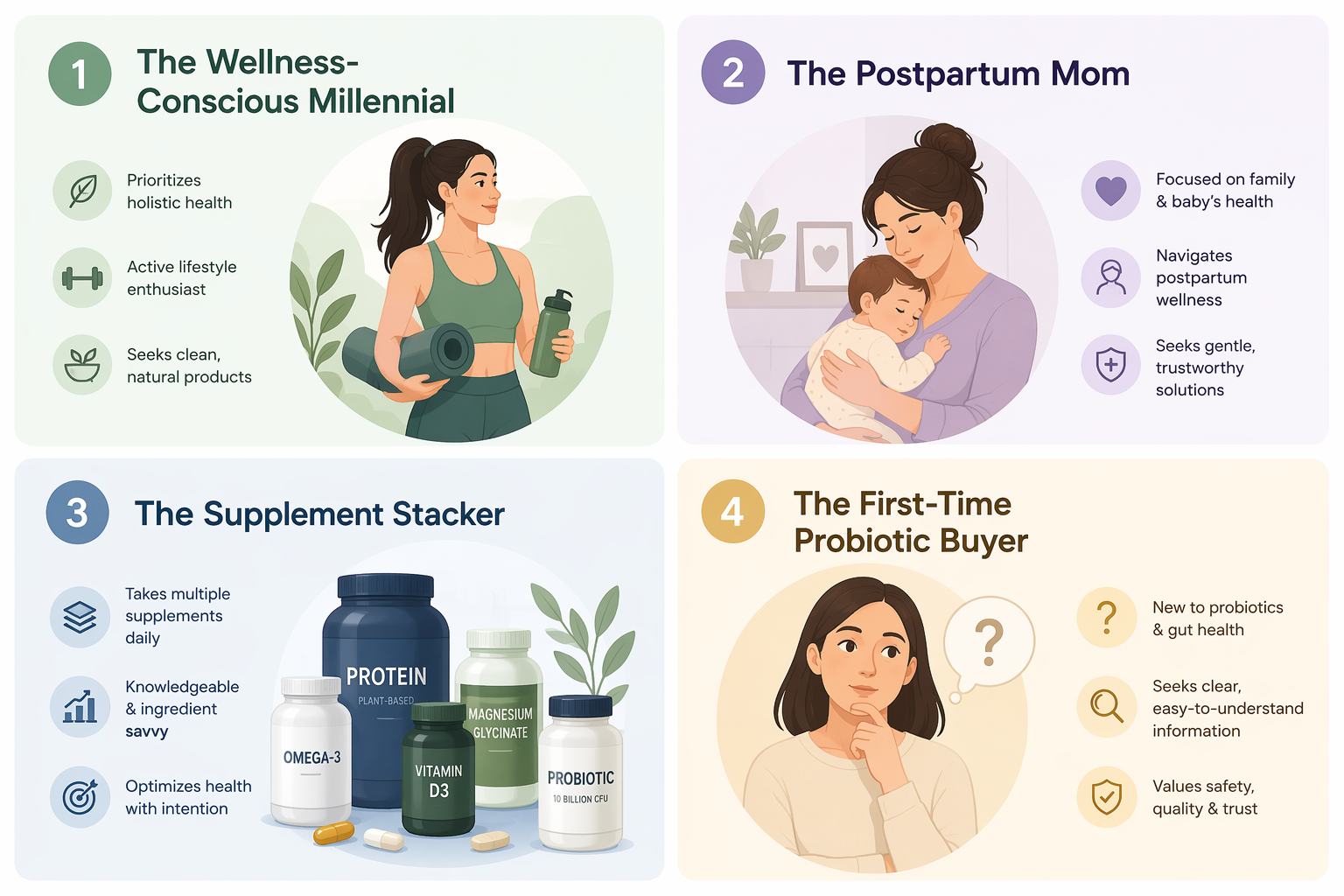
The Wellness-Conscious Millennial (Ages 25-40)
This is the largest and most active buyer segment. She's digitally native, researches products before purchasing (reading reviews, checking ingredient lists, searching Reddit and TikTok), and values transparency, clean labels, and brand authenticity. She's comfortable with subscription models and is the most likely to leave detailed product reviews. Keywords that resonate: "clean ingredients," "clinically studied strains," "no artificial sweeteners," "third-party tested."
The Supplement Stacker (Ages 30-50)
Already taking multiple supplements (multivitamins, omega-3s, collagen, vitamin D), she's adding a probiotic to her routine on the recommendation of a healthcare practitioner or based on her own research. She's brand-loyal when she finds a product that works, and she's price-sensitive — but not at the expense of quality. She compares cost-per-serving across brands and is likely to buy larger count bottles or multi-packs. For this persona, Subscribe & Save is the highest-converting offer on the listing.
The Postpartum and Prenatal Buyer (Ages 25-40)
Women during and after pregnancy are among the most motivated supplement consumers. They're often recommended probiotics by their healthcare providers and are looking for products that are safe, gentle, and free from unnecessary additives. This segment has the highest willingness to pay a premium for quality and is the most likely to become a long-term, loyal customer. However, products targeting this segment must be especially careful with marketing claims — all positioning should be around general wellness support, not specific health outcomes.
The First-Time Probiotic Buyer (Ages 20-55+)
New to probiotics, often entering through the gummy format specifically because capsules are intimidating or unpleasant. She may not fully understand the difference between strains or CFU counts — her purchase decision is driven by format (gummy), flavor variety, brand trust, and review volume. Educational content on the product page (infographics, simple strain explanations, clear benefit statements) is critical for converting this persona. Once converted, she has high lifetime value potential as her knowledge and category engagement grows over time.
5. Product Features That Drive Conversion and Reviews
Not all women's probiotic gummies are created equal — and the marketplace reflects this starkly. Analysis of top-performing listings reveals consistent patterns in the product features that correlate with higher conversion rates, better review scores, and stronger organic ranking.
Strain Transparency
Listings that specify strain deposit numbers (GR-1, RC-14, HN019, etc.) in both the title and bullet points consistently outperform those that use only generic species names. This is a trust signal that educated buyers actively look for, and it differentiates the product from the hundreds of generic "women's probiotic" listings that populate marketplace search results. For brand owners, the strain specification is a defensible point of differentiation — it's difficult for competitors to copy if your supply chain is built around specific clinically validated strains.
CFU Guarantee Language
Top-performing listings almost universally include language like "CFU guaranteed at expiration" or "CFU guaranteed through expiration date" — not just "X billion CFU." This single distinction is one of the most powerful conversion elements on a probiotic product page, because it addresses the primary concern of informed buyers: "Is this product actually potent when I take it?" Products that only guarantee CFU at manufacture, even with higher stated counts, consistently underperform on review ratings.
Sugar Content and Clean Label
Women's probiotic gummies with sugar content under 2g per serving see higher engagement and better review sentiment than those with 3g+ per serving. The "healthy gummy" paradox — a product that claims health benefits while delivering significant sugar — is a common negative review theme. Products using sugar alcohols (erythritol, xylitol) or natural sweeteners (stevia, monk fruit) outperform sugar-sweetened alternatives. Additionally, "free from" claims — gluten-free, dairy-free, soy-free, non-GMO — now function as table stakes rather than differentiators in this category.
Packaging That Communicates Without Overpromising
The most successful women's probiotic gummy packaging strikes a careful balance: it signals femininity and wellness without veering into clinical or medical territory (which triggers compliance issues). Clean typography, botanical illustrations, soft pastel or earth-tone color palettes, and clear benefit callouts — "Digestive + Vaginal + Immune Support" — are the visual language of the category's bestsellers. For more on regulatory-compliant labeling, see our article on key ingredients and quality standards for women's probiotic gummies.
| Feature | Impact on Conversion | Impact on Reviews | Impact on Ranking |
|---|---|---|---|
| Strain deposit numbers on label | ★★★★★ High | ★★★☆☆ Moderate | ★★★★☆ Significant |
| CFU guaranteed at expiration | ★★★★★ High | ★★★★★ High | ★★★★☆ Significant |
| Sugar ≤ 2g per serving | ★★★☆☆ Moderate | ★★★★★ High | ★★☆☆☆ Indirect |
| Multi-strain formula (4+ strains) | ★★★★☆ Significant | ★★★☆☆ Moderate | ★★★★☆ Significant |
| Sustainable/eco-friendly packaging | ★★★☆☆ Moderate | ★★★★☆ Significant | ★★☆☆☆ Indirect |
| Third-party tested certification | ★★★★☆ Significant | ★★★★☆ Significant | ★★★☆☆ Moderate |
Already have a women's probiotic product idea? Ahualyn's women's probiotic gummies OEM service includes strain-specific formulation, CFU-at-expiration guarantees, clean-label sweetener systems, premium packaging design support, and full regulatory documentation — everything you need to launch a competitive e-commerce listing.
Explore the Product Line →6. Sourcing to Win: What E-Commerce Sellers Need From Manufacturers
The product is the business. For e-commerce sellers, the manufacturer relationship determines whether a product launch succeeds or fails. Here are the sourcing factors that matter most for e-commerce success — beyond the standard quality and compliance requirements covered in our sourcing guide:
MOQ Flexibility for Market Testing
E-commerce brands often need to test the market before committing to large production runs. The standard MOQ for custom-formulated probiotic gummies is 3,000-10,000 units per SKU, but manufacturers serving the e-commerce channel increasingly offer starter programs at 1,000-3,000 units. These smaller runs allow brands to validate demand, collect initial reviews, and iterate on formulation or packaging before scaling. When evaluating manufacturers, ask specifically about their e-commerce starter programs — not all manufacturers accommodate smaller runs without significant per-unit cost penalties.
Speed-to-Market
E-commerce is a speed game. A formulation that takes six months to develop is a formulation that misses a selling season. Manufacturers with premixed base formulations that can be customized with brand-specific packaging, flavor, and supplementary ingredients can reduce lead time from 12+ weeks to 4-8 weeks. For fully custom formulations, standard lead time is 8-12 weeks. Ask manufacturers to provide a timeline breakdown: formulation (weeks 1-2), pilot batch and stability testing (weeks 3-6), production (weeks 7-8), and packaging/labeling (weeks 8-10), with shipping adding 2-4 weeks depending on destination.
Multi-Market Regulatory Support
One of the advantages of e-commerce is the ability to sell across borders. But each market has its own regulatory requirements — FDA for the US, EFSA for Europe, NMPA for China, TGA for Australia, and so on. A manufacturer who understands cross-border compliance can save months of regulatory friction and potentially millions in reformulation costs. Key questions to ask: Does the manufacturer have FDA facility registration? Can they provide the documentation required for EU Novel Foods compliance? Do they have experience with Amazon's Supplement Policy requirements, including the recently tightened enforcement on listing accuracy and documentation?
Packaging for the Digital Shelf
In e-commerce, the package is not just a container — it's the primary marketing asset after the main product image. Packaging designed for shelf visibility (bright colors, large text) often performs worse on e-commerce than packaging designed for digital display. Key considerations: the front label should be legible in a thumbnail (150x150px), the key benefit should be readable without zooming, and the overall design should photograph well on a white background. Manufacturers who offer packaging design support — including 3D renders for listing images — provide a significant time-to-market advantage.

Supply Chain Resilience
Nothing kills an Amazon listing faster than going out of stock. A product that's unavailable for even two weeks can lose months of accumulated ranking momentum. Key factors: the manufacturer's production capacity buffer (can they handle a 2x increase in order volume on 4-6 weeks' notice?), raw material sourcing redundancy (do they have backup suppliers for key strains and ingredients?), and geographic diversification (are production facilities distributed to reduce single-point-of-failure risk?). These are not questions most new brand owners think to ask — but experienced e-commerce sellers know they're among the most important.
7. Frequently Asked Questions
Why are women's probiotic gummies selling so well online?
Three converging trends drive this category: the broader women's health supplement market growing at 5-8% annually, the consumer shift to gummy formats (which now account for over 25% of supplement launches), and probiotics becoming a daily-routine staple. Women's probiotics specifically benefit from multi-benefit positioning — one SKU addresses digestive, vaginal, urinary, and immune health — maximizing conversion across multiple search terms and consumer needs. For e-commerce sellers, this means one product captures demand that would require multiple SKUs in other categories.
What makes a women's probiotic gummy product successful on Amazon?
Success on Amazon requires five elements: clinically validated strains with deposit numbers (L. rhamnosus GR-1, L. reuteri RC-14), CFU guarantee at expiration (not just manufacture), balanced sugar content (under 2g per serving), brand-differentiated packaging that communicates women's health without being overly clinical, and 4+ star review velocity. Products that combine urogenital strains with complementary ingredients like cranberry extract and prebiotics tend to generate stronger repeat purchase rates and higher subscription enrollment. For more on the technical aspects of formulation, see our sourcing and ingredients guide.
What is the minimum order quantity for launching a women's probiotic gummy brand?
Typical MOQs for custom-formulated probiotic gummies range from 3,000 to 10,000 units per SKU, though some manufacturers offer flexible starter programs as low as 1,000 units. Premixed base formulations with custom packaging can reduce lead time to 4-6 weeks. Standard lead time for fully custom formulations is 8-12 weeks, including stability testing and regulatory review. Ahualyn offers both fully custom and semi-custom options with competitive MOQs — reach out to discuss your requirements.
How do I differentiate my women's probiotic gummy brand in a competitive e-commerce market?
Differentiation strategies include: (1) specializing by life stage — prenatal, postpartum, perimenopause, or menopause formulations; (2) targeting specific benefit combinations — probiotics + cranberry + vitamin D3 for comprehensive women's health, or probiotics + collagen + biotin for beauty-from-within positioning; (3) premium packaging with eco-friendly materials and e-commerce-optimized design; (4) clinically validated strain exclusivity; (5) higher CFU counts with robust expiration guarantees; and (6) value-added digital content — such as QR codes linking to educational resources, strain information, and usage guides. Avoid competing on price alone — this is a trust-driven category where quality signals and brand reputation drive conversion more than discounts.
What certifications should a women's probiotic gummy have for e-commerce compliance?
Key certifications include: GMP (Good Manufacturing Practice) certification for your target markets; third-party lab testing for CFU verification, strain identity confirmation, and contaminant screening; and market-specific compliance such as FDA facility registration for Amazon US sales. Additional trust-building certifications that can improve conversion rates include Non-GMO Project Verified, gluten-free certification, vegan certification, and Clean Label Project verification. For Amazon specifically, products must comply with the site's dietary supplement policy, which has seen tightened enforcement on listing accuracy and supporting documentation requirements in recent years.
What's the typical timeline to launch a women's probiotic gummy on Amazon?
A realistic timeline from manufacturer selection to live listing is 14-20 weeks: manufacturer vetting and sampling (2-3 weeks), formulation and pilot batch (3-4 weeks), stability testing (4-6 weeks, can run partially in parallel), production and packaging (3-4 weeks), shipping and Amazon FBA inbound (2-4 weeks), listing optimization and launch (1-2 weeks). Rush timelines of 8-10 weeks are possible with premixed formulations and air freight, but cost increases significantly. The most common delay isn't manufacturing — it's Amazon's category approval process for dietary supplements, which has become more rigorous and can add 1-3 weeks if documentation is incomplete.


