




Walk down any pharmacy immune health aisle and you'll find an overwhelming selection of vitamin C products — effervescent tablets, chewables, capsules, powders, and an ever-growing wall of gummies. The gummy format, once considered a children's product, has become the fastest-growing segment in the adult supplement market.
But beyond the appealing taste and convenience, there's a more important question: do vitamin C gummies actually support your immune system in a meaningful way? Or are they just expensive candy with a health halo?
The answer, backed by decades of clinical research and a clear understanding of vitamin C's biological mechanisms, is that well-formulated vitamin C gummies can play a legitimate role in immune support — and for many people, the gummy format may actually be the superior delivery method, not despite being a gummy, but because of it.
This guide walks through the science, the clinical evidence, and the practical considerations that separate effective vitamin C gummies from the rest.
1. How Vitamin C Supports Your Immune System
Vitamin C (ascorbic acid) is not a single-purpose nutrient. It influences immunity through at least four distinct mechanisms, which together explain why adequate intake is associated with better immune outcomes across a wide range of studies.
White Blood Cell Production and Function
Vitamin C accumulates in immune cells at concentrations 10–100 times higher than in blood plasma. This isn't a coincidence — it's a functional requirement. Neutrophils, the first-responder white blood cells that engulf and destroy pathogens, depend on vitamin C for both their production in the bone marrow and their ability to migrate toward infection sites (a process called chemotaxis).
When vitamin C levels are suboptimal, neutrophil chemotaxis slows down. Think of it as a fire department responding to a call with half its engines out of service — the response still happens, but it's slower and less effective.
Antioxidant Protection for Immune Cells
When immune cells destroy bacteria or viruses, they generate reactive oxygen species (ROS) — essentially, they use oxidative bursts as weapons. The problem is that these same oxidative bursts can damage the immune cells themselves. Vitamin C, as a water-soluble antioxidant, neutralizes excess ROS within immune cells, protecting them from self-inflicted damage during an immune response. This allows immune cells to function longer and more effectively during an active infection.
Skin Barrier Integrity
The skin is the body's first line of defense, and vitamin C is essential for its structural integrity. It serves as a cofactor for enzymes that cross-link collagen fibers in the dermis, maintaining the physical barrier that pathogens must cross to enter the body. It also supports keratinocyte differentiation — the process by which skin cells mature into a protective outer layer — and promotes wound healing, which closes entry points for infection.
Inflammatory Regulation
Vitamin C modulates the production of inflammatory signaling molecules (cytokines) and reduces markers of oxidative stress. During an infection, this helps prevent the immune response from overshooting — a phenomenon known as a cytokine storm — where excessive inflammation causes more damage than the pathogen itself. Vitamin C also helps recycle vitamin E (a fat-soluble antioxidant), extending the body's total antioxidant capacity.
2. What the Clinical Research Shows
Vitamin C is one of the most studied nutrients in clinical nutrition, with decades of randomized controlled trials, systematic reviews, and mechanistic studies. Here's what the highest-quality evidence tells us:
The Landmark Cochrane Review
Design: Systematic review of 29 placebo-controlled trials involving 11,306 participants. Analyzed the effect of regular vitamin C supplementation (≥200 mg/day) on the incidence, duration, and severity of the common cold.
Key findings: Regular supplementation did not reduce cold incidence in the general population, but reduced cold duration by 8% in adults and 14% in children. In marathon runners, skiers, and soldiers exposed to extreme physical stress, vitamin C halved the risk of developing a cold. Doses of 1–2 g/day in children shortened colds by 18%.
View on Cochrane Library →
Vitamin C and Immune Cell Function
Design: Comprehensive review of vitamin C's role in immune function, covering mechanisms, deficiency states, and clinical implications.
Key findings: Vitamin C supports both the innate and adaptive immune systems. It enhances the proliferation and differentiation of B-cells and T-cells, supports the production of interferon (a key antiviral protein), and protects immune cells from oxidative damage during active infection. Deficiency — even subclinical — impairs multiple aspects of immunity.
View on PubMed →
Immune-Enhancing Effects of Vitamin C and Zinc
Design: Review of clinical and experimental data on vitamin C, zinc, and other micronutrients in immune function.
Key findings: Combined supplementation with vitamin C and zinc showed complementary immune effects: vitamin C enhances neutrophil activity and antioxidant defense, while zinc is essential for natural killer cell function and T-cell development. Deficiency in either nutrient impairs distinct but overlapping aspects of immunity.
View on PubMed →
The takeaway: The evidence doesn't support the idea that vitamin C prevents colds in the general population — but it does consistently show that adequate intake shortens illness duration, reduces symptom severity, and provides substantial protection for individuals under physical stress. For daily immune support, consistency (daily intake at 200–500 mg) matters far more than megadosing only when you feel sick.
3. Why Gummies? The Compliance Advantage
If the clinical benefit of vitamin C depends primarily on consistent daily intake, then the most important feature of any vitamin C product is not its potency — it's whether people actually take it every day. This is where the gummy format has a genuine, underappreciated advantage.
The Adherence Problem with Pills
Research on supplement adherence consistently shows that 30–50% of people who buy supplements do not take them regularly. The reasons are predictable: pills are hard to swallow, they taste unpleasant, they require water, and taking them feels like a chore. This is especially true for older adults, children, and anyone who already takes multiple medications — adding another "pill to swallow" faces psychological resistance.
How Gummies Change Behavior
Gummies transform supplementation from a medical task into a pleasant daily ritual:
- Taste drives habit formation: A pleasant-tasting gummy creates positive reinforcement. You're more likely to remember — and want — to take it.
- No water, no swallowing difficulty: Gummies dissolve in the mouth and are easy to chew, removing the physical barriers that cause people to skip pills.
- Visual appeal and portion clarity: Gummies are visually distinct and pre-portioned. You can see exactly what you're taking, and the act of chewing provides a sensory experience that pills lack.
- Family-friendly format: A single gummy product can serve multiple age groups, simplifying household supplementation routines.
Format Comparison: Gummies vs. Alternatives
| Format | Adherence Rate | Taste | Convenience | Best For |
|---|---|---|---|---|
| Gummies | ★★★★★ Highest | ★★★★★ Pleasant,fruity | ★★★★★ No water,portable | Daily immune maintenance, families, children |
| Chewable Tablets | ★★★★☆ High | ★★★☆☆ Often chalky | ★★★★☆ Portable | Those who prefer tablets, mixed household use |
| Effervescent Tablets | ★★★☆☆ Moderate | ★★★★☆ Good (dissolved) | ★★☆☆☆ Requires water/glass | Higher single-dose needs, hydration context |
| Capsules / Tablets | ★★☆☆☆ Lowest | ★☆☆☆☆ Neutral/none | ★★★★☆ Portable | High-dose, no taste preference |
| Powders | ★★☆☆☆ Low | ★★★☆☆ Variable | ★★☆☆☆ Needs mixing | Dose flexibility, smoothie integration |
The bottom line: a 500 mg tablet that sits in the bottle delivers zero immune support. A 200 mg gummy taken every day delivers real, cumulative benefit. In supplementation, the best format is the one you'll actually use.
4. What to Look For in a Quality Vitamin C Gummy
Not all gummies are created equal. The gummy format introduces formulation challenges — sugar content, heat stability, and ingredient interactions — that don't exist with simpler formats. Here's what to look for:
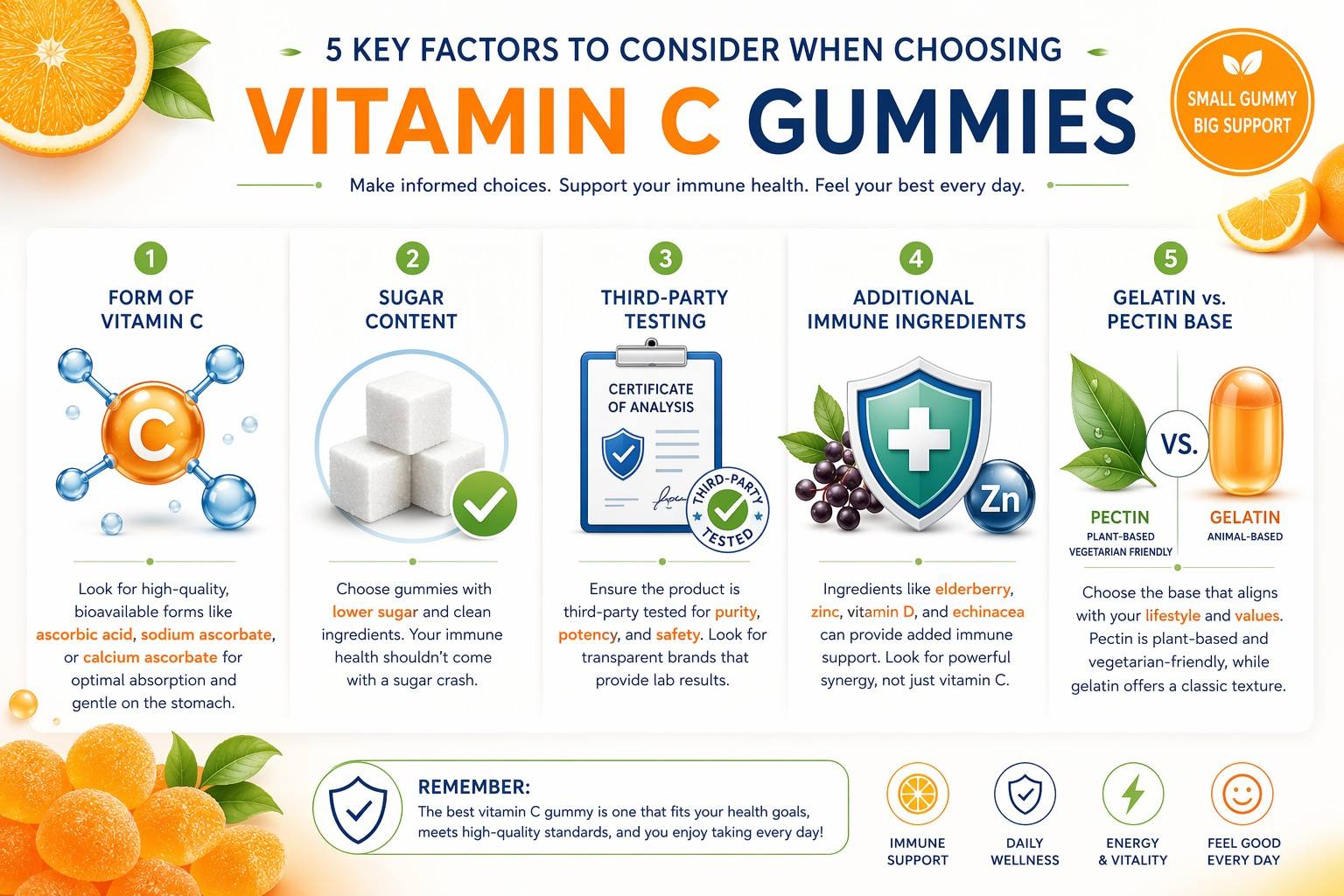
Form of Vitamin C Used
- Sodium ascorbate / calcium ascorbate (Recommended): These mineral-buffered forms are less acidic than pure ascorbic acid, making them gentler on the stomach and tooth enamel. They're the preferred choice for gummies because they maintain stability better in a moist, low-pH matrix.
- Ascorbic acid: The pure form. More acidic, which can cause stomach discomfort at high doses and may contribute to enamel erosion over time. Often less stable in gummy formulations.
- Ascorbyl palmitate: A fat-soluble form of vitamin C. Less common in gummies; more often used in topical products. Absorption profile differs from water-soluble forms.
Sugar Content and Sweeteners
Many mass-market gummies contain 2–4 grams of sugar per serving — the equivalent of eating a piece of candy. For daily supplementation, that adds up to 60–120 grams of unnecessary sugar per month. Look for:
- Total sugar content ≤ 2g per serving
- Natural sweeteners (stevia, monk fruit) as alternatives to high-fructose corn syrup
- No artificial colors or flavors — natural fruit and vegetable extracts for coloring
Gelling Agent: Pectin vs. Gelatin
- Pectin (plant-based): Derived from fruit. Suitable for vegetarians and vegans. Creates a softer, fruit-snack-like texture. More stable in varying temperatures.
- Gelatin (animal-based): Derived from animal collagen. Creates a firmer, more traditional gummy texture. Not suitable for vegetarians. May melt in high temperatures during shipping.
Quality Markers
- Third-party testing: Look for products tested by independent labs (USP, NSF, or equivalent) for label accuracy and purity.
- GMP certification: Ensures the manufacturing facility follows Good Manufacturing Practices for consistent quality.
- Clear expiration dating: Vitamin C degrades over time, especially in gummy form where moisture accelerates oxidation. A clear "best by" date is non-negotiable.
Watch Out for "Vitamin C" Gummies That Are Mostly Sugar
Some products in the market contain as little as 30–60 mg of vitamin C per gummy — barely above the RDA for a child — while delivering 3–5 grams of added sugar per serving. Read the Supplement Facts panel carefully: the first ingredient should be a form of vitamin C, not glucose syrup or sugar. For adult immune support, target formulations delivering 200–500 mg of vitamin C per serving.
5. Dosage: How Much Do You Really Need?
Vitamin C dosing falls along a spectrum from "prevent deficiency" to "therapeutic support." Understanding where you fall on that spectrum helps determine the right daily intake.
| Purpose | Daily Dose | Notes |
|---|---|---|
| Prevent deficiency (scurvy) | 10 mg/day | Bare minimum. Below this, clinical deficiency develops within weeks. |
| Meet basic RDA | 75–90 mg/day | Adequate for healthy adults with a balanced diet. |
| Daily immune maintenance | 200–500 mg/day | The sweet spot supported by most clinical studies. Provides immune cell saturation without significant side effects. |
| During illness or high stress | 500–1,000 mg/day | Short-term use. May reduce cold duration. Split into 2–3 doses for better tolerance. |
| Therapeutic (medical context) | 1,000–2,000 mg/day | Only under guidance. Higher doses increase GI side effect risk without proportional immune benefit. |
Absorption Dynamics: Why More Isn't Always Better
Vitamin C absorption follows a saturation curve. At doses up to about 200 mg, absorption efficiency is high (~70–90%). At 1,000 mg, absorption efficiency drops below 50%, and at higher doses it falls further — the excess is simply excreted in urine. This is why taking 2,000 mg at once is less effective than taking 500 mg four times throughout the day.
For gummies specifically, this absorption profile has an interesting implication: because gummies are typically taken as 1–2 pieces containing 100–250 mg each, they naturally encourage the moderate, consistent dosing pattern that maximizes absorption efficiency.
Special Populations
- Smokers: Need an additional 35 mg/day above the standard RDA, as smoking increases oxidative stress and accelerates vitamin C turnover.
- Athletes and physically active individuals: May benefit from 200–500 mg/day, particularly during training intensification or competition seasons.
- Older adults: Absorption efficiency declines with age, and dietary intake often decreases simultaneously. A daily 200–500 mg supplement can help bridge the gap.
- Pregnant and breastfeeding women: RDA increases to 85 mg/day (pregnancy) and 120 mg/day (breastfeeding). Always consult an OB-GYN before adding supplementation.
Developing an immune health supplement line? Ahualyn provides OEM/ODM services for vitamin C gummies, immune support formulations, and functional gummy products — with custom flavors, shapes, and ingredient profiles backed by GMP-certified manufacturing.
Talk to Our OEM Team →6. Beyond Vitamin C: Immune-Boosting Ingredient Synergies
While vitamin C is a powerful standalone immune nutrient, it works even better when paired with complementary ingredients that address different aspects of immune function. Many of the most effective immune gummies on the market use a multi-ingredient approach.
Vitamin C + Zinc
This is the most evidence-backed immune pairing. Zinc is essential for the development and function of natural killer cells, neutrophils, and T-lymphocytes. While vitamin C neutralizes oxidative stress during immune activity, zinc provides the structural and enzymatic support for immune cell proliferation. The Wintergerst et al. (2006) review highlighted that combined vitamin C and zinc supplementation produced complementary immune effects that neither nutrient achieved alone.
Vitamin C + Elderberry
Elderberry (Sambucus nigra) contains anthocyanins — flavonoid compounds with demonstrated antiviral properties. A 2004 randomized trial (Zakay-Rones et al., Journal of International Medical Research) found that elderberry extract significantly reduced the duration and severity of influenza symptoms. When combined with vitamin C, elderberry addresses the viral inhibition angle while vitamin C supports the broader immune response.
Vitamin C + Vitamin D3
Vitamin D3 modulates both innate and adaptive immunity, with particular effects on antimicrobial peptide production and regulatory T-cell function. While vitamin C works primarily as an antioxidant and cellular energy source for immune cells, vitamin D3 regulates the signaling pathways that coordinate the overall immune response. Together, they cover more immunological ground than either alone. For more on vitamin D's broader health role, see our guide on the magnesium-calcium-vitamin D triangle.
Vitamin C + B-Complex
B vitamins — particularly B6, B9 (folate), and B12 — support the production and maturation of immune cells. Vitamin B6 deficiency, for example, impairs lymphocyte production and antibody responses. Products like Ahualyn's Energy & Focus Gum, which combines B vitamins with functional ingredients, demonstrate how energy metabolism and immune function are interconnected systems.
7. Frequently Asked Questions
How much vitamin C should I take daily for immune support?
The general RDA for adults is 75–90 mg/day, but this is the amount to prevent deficiency, not to optimize immune function. For active immune support, most clinical studies use 200–500 mg/day. During illness or high physical stress, short-term use of 1,000–2,000 mg/day may provide additional benefit. Because absorption efficiency drops above ~200 mg per dose, split higher intakes into 2–3 servings throughout the day rather than taking one large dose.
Are vitamin C gummies as effective as vitamin C tablets?
When properly formulated, yes. The effectiveness of a vitamin C supplement depends on the form of vitamin C (ascorbic acid vs. mineral ascorbates), the actual dose per serving, and ingredient stability — not on whether it's a gummy, tablet, or capsule. Mineral ascorbate forms (sodium ascorbate, calcium ascorbate) commonly used in gummies are actually gentler on the stomach than pure ascorbic acid tablets. The key advantage of gummies — higher daily compliance — often makes them more effective in practice than higher-dose tablets that are taken inconsistently.
Can I take vitamin C gummies every day?
Yes. Daily vitamin C supplementation at doses up to 1,000 mg is safe for the vast majority of healthy adults. Because vitamin C is water-soluble, excess amounts are excreted in urine rather than accumulating in the body. The primary side effect of excessive intake is gastrointestinal discomfort (bloating, diarrhea), which resolves when the dose is reduced. Individuals with a history of calcium oxalate kidney stones should consult a healthcare provider before high-dose vitamin C supplementation, and anyone with hemochromatosis (iron overload disorder) should exercise caution, as vitamin C enhances iron absorption.
At what age can children start taking vitamin C gummies?
Children's vitamin C gummies are typically formulated for ages 4 and up, with doses ranging from 15–45 mg for young children and 45–75 mg for adolescents, in line with age-appropriate RDAs. Adult-formula gummies should not be given to children, as they contain higher doses that aren't appropriate for smaller bodies. Always keep gummy vitamins out of children's reach — their candy-like appearance creates a risk of overconsumption. Consult a pediatrician before starting any supplement for a child, especially one with underlying health conditions.
What ingredients should I look for alongside vitamin C in a gummy?
Zinc is the strongest evidence-backed partner for vitamin C in immune formulations. Elderberry and echinacea are commonly included for their antiviral and immune-modulating properties. Vitamin D3 supports immune regulation from a different angle. For those seeking broader nutritional support, B vitamins complement vitamin C's energy and metabolic roles. Rather than trying to find every ingredient in a single gummy, consider whether a focused vitamin C + zinc gummy combined with a separate vitamin D supplement might give you more control over dosing. For more ideas on complementary approaches, see our articles on magnesium for recovery and caffeine + L-theanine for clean energy — supporting different aspects of wellness works best when each piece is addressed properly.
Can vitamin C gummies replace fruits and vegetables?
No. Whole fruits and vegetables provide vitamin C in a matrix that includes fiber, polyphenols, other vitamins, and phytonutrients that work together in ways a single-nutrient supplement cannot replicate. A vitamin C gummy is a supplement — it supplements a healthy diet, it doesn't replace one. The goal is not to use gummies as a substitute for eating oranges and bell peppers. The goal is to ensure consistent, adequate vitamin C intake on top of a produce-rich diet, especially during seasons or situations where dietary intake may be less reliable.


